Mama’s Kitchen Helper
A Whimsical Embroidery Design for the Little Chef
As a designer who frequently evaluates embroidery files for real-world use, I often find myself drawn to designs that balance charm with practicality. Mama’s Kitchen Helper is one such design. It’s not just another kitchen-themed pattern—it’s a thoughtful blend of whimsy and function that feels right at home in a variety of handmade projects.
The First Impression: A Warm and Playful Mood
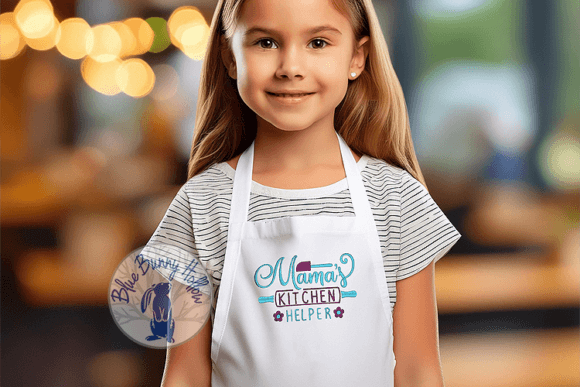
At first glance, Mama’s Kitchen Helper evokes a sense of warmth and playfulness. The central elements—a spatula, a rolling pin, and delicate flowers—create a visual harmony that feels both nostalgic and modern. The design is intentionally soft, with rounded edges and gentle curves that invite a sense of comfort. This makes it particularly well-suited for items like baby clothes or nursery decor, where a soothing aesthetic is key.
What stands out most is the visual personality of the design. It doesn’t try to be overly complex or intricate; instead, it leans into simplicity with a touch of charm. This approach works well for both custom apparel and personalized gifts, especially when used on lighter-colored fabrics or as a subtle accent on darker backgrounds.
Real-Life Use Case: A Custom Tote Bag for a Baby Shower
To better understand how Mama’s Kitchen Helper performs in practice, imagine using it on a custom tote bag for a baby shower. The design would sit comfortably near the top of the bag, adding a playful touch without overwhelming the overall look. The spatula and rolling pin are rendered with enough detail to be recognizable but not so detailed that they become cluttered on fabric.
When testing this design on scrap fabric, I noticed that the stitch density is well-balanced. The satin stitch used for the flowers is smooth and even, while the fill stitch adds depth without creating unnecessary bulk. The running stitch outlines the main elements, giving the design a clean and cohesive feel.
One thing to consider is the hoop size. While the design isn’t overly large, it may require a medium hoop for optimal stitching. For those working with smaller hoops, it’s worth checking whether the design can be scaled down without losing clarity. Testing on scrap fabric before committing to a final product is always a good idea, especially when working with digital embroidery files.
Where to Use With Caution
While Mama’s Kitchen Helper is versatile, there are a few scenarios where it might need extra care. For instance, using it on thin or stretchy fabric could lead to distortion, especially around the curved parts of the spatula and rolling pin. In such cases, using a proper stabilizer is essential to maintain shape and stitch integrity.
Additionally, the delicate flowers might not hold up well on dark fabric unless the thread colors are chosen carefully. Testing the design in black and white mockups can help identify potential issues with contrast and visibility. Similarly, if you plan to use this design on a layered garment or a curved surface like a cap, make sure the design allows for flexibility without compromising detail.
Visual Appeal and Product Value
The visual appeal of Mama’s Kitchen Helper is undeniable. Its playful nature makes it ideal for personalized gifts, holiday embroidery, and small shop products. However, its value also depends on how well it integrates with the overall design of the finished product.
For handmade products, the design’s simplicity allows it to stand out without overshadowing other elements. On a sweatshirt or apron, it can serve as a charming focal point, especially when paired with complementary colors or patterns. But for more complex projects, like commercial embroidery or design assets, it’s important to ensure that the design maintains clarity and legibility across different scales and applications.
Practical Designer Notes
- Test on scrap fabric: Always test new designs on scrap before proceeding with a final project.
- Check thread color contrast: Ensure the thread colors provide enough contrast against the fabric background.
- Review stitch density: Confirm that the stitch density is appropriate for the intended fabric type and application.
- Confirm hoop size: Make sure the design fits within your hoop without stretching or distorting.
- Inspect small details: Pay close attention to tiny lettering or intricate accents that might be lost in the final product.
- Use proper stabilizer: Especially for stretchy or textured fabrics, a quality stabilizer is crucial.
- Check for commercial use: If planning to sell finished items or digital products, confirm licensing terms before proceeding.
- Compare light and dark backgrounds: This helps determine how the design will appear in different contexts.
- Consider buyer engagement: A well-chosen design can significantly impact customer trust and brand consistency.
Final Thoughts
Mama’s Kitchen Helper is a versatile and charming design that offers a great balance between whimsy and practicality. Whether you’re creating a custom embroidered patch, a holiday gift, or a small shop product, this design has the potential to add a touch of personality and warmth to your projects.
With the right preparation, including testing on scrap fabric and considering fabric type, Mama’s Kitchen Helper can be a valuable addition to your craft business or Etsy listing. It’s a design that feels right at home in a wide range of embroidery projects, from personalized gifts to commercial embroidery.